How to Choose an Assisted Living Facility in San Antonio, TX
A practical framework for comparing daily support, location, licensing, costs, contracts and tour impressions before choosing assisted living in San Antonio.
Choosing a residence for a parent or spouse is easier when the decision is broken into observable needs and verifiable answers. Learning how to choose an assisted living facility in San Antonio TX means separating three questions: what help is needed each day, whether a particular home can reliably provide it, and how the arrangement will work financially over time. A pleasant tour matters, but it cannot substitute for a license check, specific answers and a readable contract.
Start with a written picture of daily needs
Begin with a typical day, including mornings, evenings and overnight. Write down what the person does independently, what requires prompting and what requires hands-on help. Include bathing, dressing, toileting, eating, mobility, medication routines, meal preparation and getting to appointments. Separate occasional difficulty from help needed every day.
Also describe communication and memory support in concrete terms. Note missed meals, getting lost, difficulty using a phone or call device, disrupted sleep, or confusion about familiar routines. These observations are more useful during an inquiry than a broad label such as “needs more help.”
Ask each community which tasks staff support, which require an outside provider and which would require a move. Ask how needs are assessed before move-in, who receives the care plan, and when it is reviewed after a change. The goal is not to predict every future need. It is to avoid choosing a setting that fits only the best days.
How to choose an assisted living facility in San Antonio TX
San Antonio’s size makes the address part of the care decision. Map the drive from the homes and workplaces of the people most likely to visit, then travel the route at the times visits would actually occur. Include a spouse who may prefer not to drive on busy highways and an adult child coming after work.
The William Senior Living is at 9203 Cinnamon Hill Dr in northwest San Antonio, in the 78240 ZIP code and Bexar County. Families whose routines involve Leon Valley, Loop 410, Interstate 10 or the South Texas Medical Center area can compare that location with their own routes rather than relying on a map estimate alone.
Location also affects ordinary participation. Ask how visitors are welcomed and how families receive updates. Consider whether the route feels manageable in rain or after dark. Frequent, workable visits can provide continuity, while an exhausting trip can quietly reduce contact. Convenience should not outweigh care fit, but it deserves a place on the comparison sheet.
Match the Texas license and inspection history to the needs
Texas Health and Human Services licenses assisted living facilities under state regulations. Its assisted living facility guidance explains two relevant license types. In a Type A facility, residents must be able to evacuate without help, follow emergency directions and not need routine nighttime attendance. In a Type B facility, residents may need staff assistance to evacuate, may be unable to follow emergency directions and may need nighttime attendance.
These categories are not quality grades. The question is whether the license and service plan match the person. Ask to see the current license, latest available inspection report and corrective documentation. Use the HHSC page as a starting point for state information, verify the license with the agency, and ask about its current process for reviewing inspection or complaint history.
A Texas facility that advertises care for Alzheimer’s disease or related disorders must also hold the required Alzheimer’s certification. When exploring memory care, ask how supervision, daily routines, environmental cues and family communication are organized, and what changes would exceed the support available. Memory care should be discussed as support and environment, not as a promise to change the course of a condition.
Compare a smaller residential setting with a larger community
A smaller residential setting and a larger community can both be appropriate, but they ask different things of a resident. A smaller layout may feel easier to learn and may offer a more predictable daily setting. A larger campus may offer more activity spaces, dining options or scheduled events, while requiring more wayfinding and communication between departments. These are possibilities to test, not guarantees.
Do not infer personal attention from size, décor or a quiet lobby. Ask who gets to know a resident’s routines, how information passes between shifts, and who answers questions on evenings and weekends. Request an explanation of how calls for assistance are received and documented. Observe whether staff address residents respectfully and allow time for unhurried interactions.
When comparing assisted living in San Antonio, use the same questions at every property. The William Senior Living offers assisted living and memory care; a tour should still establish which setting and service plan fit the written needs list, rather than assuming fit from the care categories alone.
Build a budget from San Antonio costs, then verify every charge
A median is a market midpoint, not a quote for any particular residence or care plan.
Use these figures to test a household budget, then obtain a written quote that reflects actual needs. They do not state The William Senior Living’s prices; families should call the community directly for current rates and ask what is included.
Compare care settings by schedule and included services
Nursing home care is a different service, not simply a more expensive version of assisted living. Cost can inform planning, but daily support needs and included services should drive the comparison.
Check payment sources without assuming eligibility
Payment sources need the same careful reading as residency agreements. Medicare’s long-term care coverage guidance states that Medicare does not cover long-term custodial care when that is the only care needed. Do not assume a hospital stay or Medicare card will pay an ongoing assisted living bill. Long-term care insurance may cover assisted living, depending on the policy; check the elimination period, benefit triggers, covered services, limits and claim documentation.
VA Aid and Attendance can increase a pension for eligible wartime-era Veterans or surviving spouses who need help with daily activities or meet other criteria described in the VA’s Aid and Attendance guidance. For Veterans, the current pension rate table lists a maximum annual pension rate with Aid and Attendance of $29,093 with no dependents, or at most $2,424 monthly if countable income were zero. These are not automatic flat payments: the pension calculation subtracts countable income, and qualifying unreimbursed care expenses may affect that calculation.
The VA net worth limit from December 1, 2025 through November 30, 2026 is $163,699. VA also reviews certain asset transfers and may apply penalties, so obtain individualized guidance before moving assets. Texas Medicaid’s STAR+PLUS assisted living services can help eligible members who meet nursing facility level-of-care requirements in a licensed, appropriately contracted facility. Members remain responsible for room and board and any applicable copayment, and interest lists may apply. Participation and eligibility must be verified for the person and property.
Require pricing transparency before comparing quotes
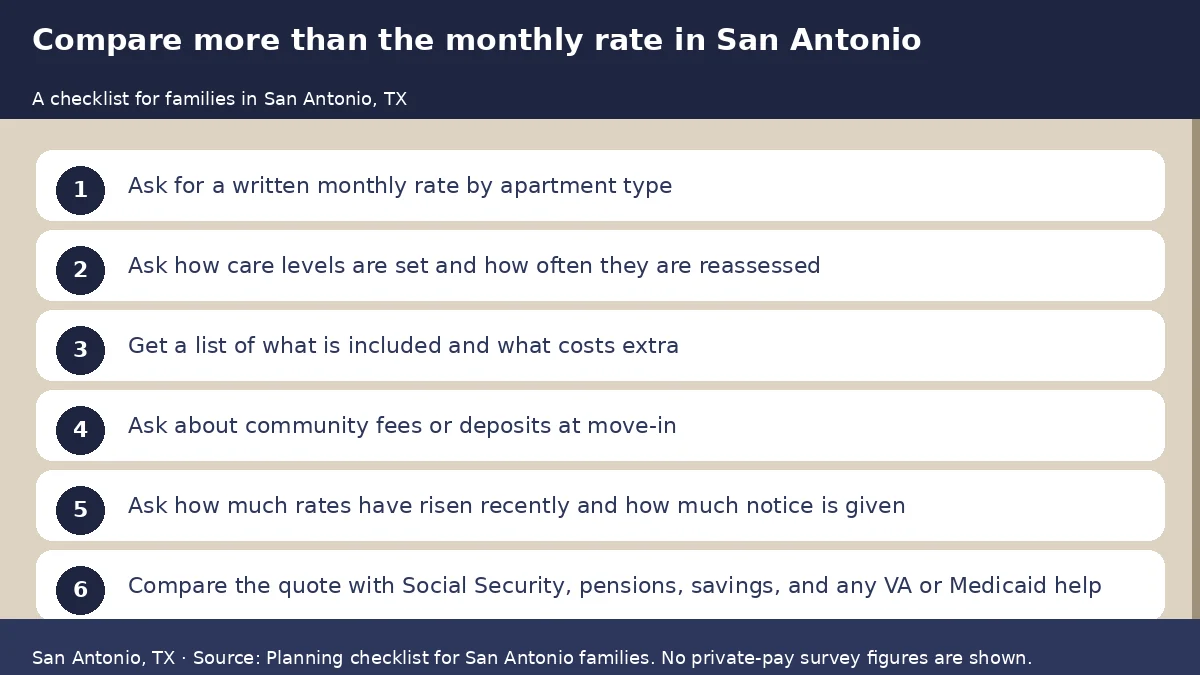
A transparent price conversation produces documents, not just a range. Ask for the base monthly charge, the current care-level charge and a written list of included services. Separately ask about meals, laundry, transportation, medication support, incontinence supplies, memory care, furnishing and any one-time charges, without assuming that a particular community bills for each item.
Request an example invoice with personal information removed and ask how reassessments can change the bill. Clarify when rate changes can occur, whether a couple’s charges differ, and which outside services remain the family’s responsibility. Compare properties using the same assumed needs. A lower base charge can be less useful than a higher quote if the first leaves out support the resident needs every day.
Read the contract and discharge policies together
Read the residency agreement and attachments before paying a deposit. Look for admission criteria, the assessment process, fee changes, notice requirements, refund terms, absences and hospital bed-hold provisions. Ask who may terminate the agreement, under what circumstances, and how much written notice is required. Make sure verbal promises about services or charges appear in the documents you keep.
Discharge and transfer policies deserve direct discussion. Ask which changes in mobility, behavior, cognition or care needs could exceed the home’s license or services; whether an outside provider can fill a gap; and what happens after hospitalization. Also ask how the community communicates concerns, documents incidents and handles grievances. A clear policy should explain the decision process and the family’s role, not merely reserve a broad right to discharge.
Use tours to confirm answers and recognize red flags
Tour at different times and bring the same worksheet to each visit. Observe resident-staff interactions, cleanliness, noise, access to common areas and whether the environment is understandable to the person who would live there. Ask follow-up questions about anything unclear; one busy moment does not establish a pattern, but vague answers should not be waved away.
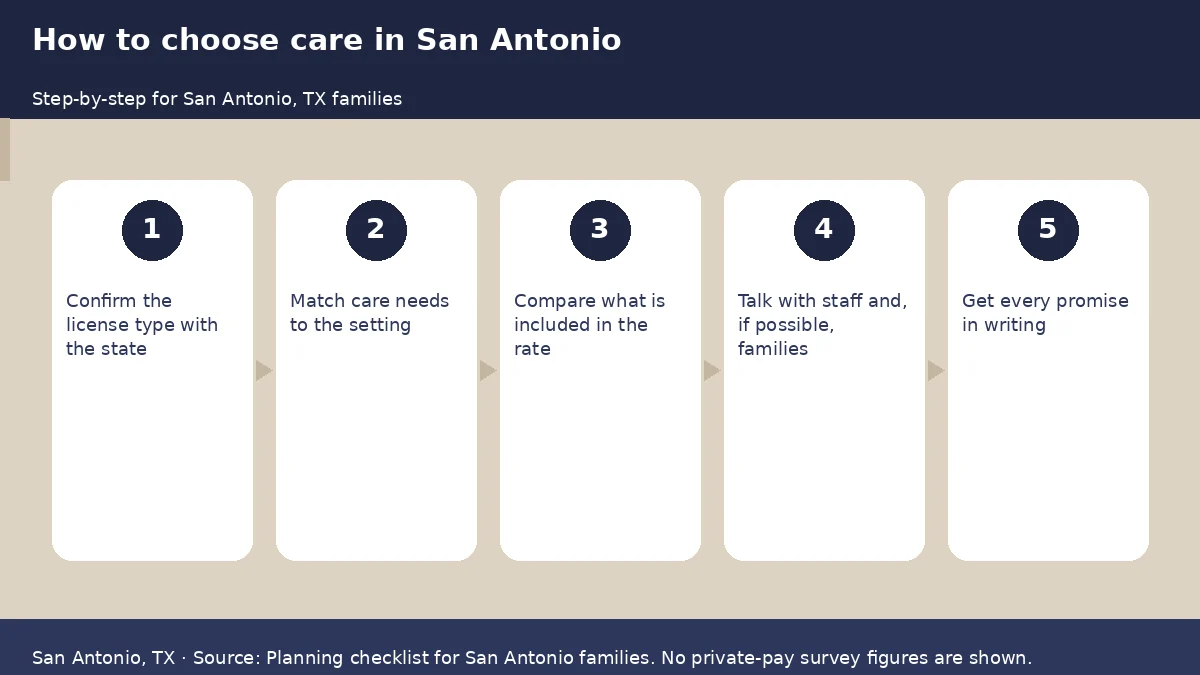
Red flags include pressure to pay before reviewing documents, reluctance to discuss licensing or inspections, unexplained charges, and an inability to identify who handles family concerns. Be cautious when answers change between staff members or when the written agreement contradicts the tour. Finish by ranking each option against non-negotiable needs, visiting practicality, regulatory fit, full monthly cost and contract clarity. That is the practical core of how to choose an assisted living facility in San Antonio TX: a decision the family can explain, document and revisit as needs change.
Frequently asked questions
What is the difference between Type A and Type B assisted living licenses in Texas?
Texas uses these license categories to describe the residents a facility is authorized to serve. Type A residents must be able to evacuate without staff help, follow emergency directions and not require routine nighttime attendance. Type B residents may need help evacuating, may not follow emergency directions and may need nighttime attendance. The categories are not quality ratings. San Antonio families should match the license to current needs, then verify licensing and inspection information with Texas Health and Human Services.
What is a realistic starting budget for assisted living in San Antonio?
A median is not a quote and does not establish what any home charges. Use it as a planning benchmark, then request a written, needs-specific quote and a list of included services. Contact The William Senior Living directly for its current rates.
Does Medicare pay for assisted living in San Antonio?
Medicare does not cover long-term custodial care when that is the only care needed, so families should not assume it will pay an ongoing assisted living bill. Long-term care insurance may help, depending on the policy’s benefit triggers, elimination period and covered services. Eligible Veterans or surviving spouses may also want to explore VA pension benefits. Texas Medicaid’s STAR+PLUS program has separate eligibility, service and provider requirements that must be verified.
What should I ask about memory care during a San Antonio tour?
Ask how the home organizes supervision, daily routines, environmental cues, assistance with personal care and communication with families. Request examples of how staff respond when a resident becomes confused or needs redirection, without expecting promises about medical outcomes. If a Texas facility advertises care for Alzheimer’s disease or related disorders, ask to see its required Alzheimer’s certification. Also ask which changes in needs can be supported and what circumstances would require a transfer or discharge.
Is northwest San Antonio a practical location for family visits?
That depends on the routes family members will actually travel. The William Senior Living is at 9203 Cinnamon Hill Dr in the 78240 ZIP code. Adults whose routines involve Leon Valley, Loop 410, Interstate 10 or the South Texas Medical Center area should drive the route at likely visiting times. Consider after-work traffic, rain, nighttime driving and whether a spouse is comfortable making the trip alone. A workable location supports regular visits, but it should be weighed alongside care fit, licensing, costs and contract terms.
Talk with The William Senior Living
If you are weighing care options in San Antonio, call (737) 313-2131 or visit and tour. Our team can talk through current availability, rates and next steps. Please confirm all details directly, since published figures and listings change over time.
Sources
- VA Aid and Attendance and Housebound benefits
- VA pension rates (current)
- Medicare: long-term care coverage
- ACL: What is long-term care insurance
- Texas HHS: Assisted Living Facilities (ALF)
- Texas HHS STAR+PLUS Handbook 7200: Assisted Living Services
Program rules and benefit amounts were checked on the linked official pages in November 2026 and can change.
Related reading on this site: